Showing posts with label Plants. Show all posts

Monday, 19 October 2015

Day 339 - Surprisingly Popular Scarlet Pimpernel

Scarlet Pimpernel (Anagallis arvensis)
Hey everyone today's Day 339 and as I have covered Orchids in the the last couple of days, I was in the flower mood. So today I decided to visit something that I found quite a little bit ago in Summer at a place called Nosterfield, a place I love to go to. It's my nearest local nature reserve but it has so many wonderful things, not just birds and bugs (all of which I cover an awful lot) but lots of great plant-life too. Today's post will be about the lovely Scarlet Pimpernel.

So, here are the facts:
  • The reason that they are called the 'Scarlet Pimpernel' is because of the lovely colour that they are. 
  • Now, I'm colour-blind so I can't really see what the colour is, all I can see is an orangey-red colour that looks like all other things that are orange, so I'm going by what my Dad says. :-)
  • They are seen mostly through out Summer, a little bit into both Spring and Autumn, strictly speaking May to September.
  • The particular habitats the The Wildlife Trusts say are mainly Gardens and Fields, Grassy areas. This seems right from where I found it.
    'No heart can think, no tongue can tell
    The virtues of the Pimpernel.'
  • Some of its other names are the 'Old Man's Weather-Vane' or the 'Shepherd's Weather Glass'. I wonder why that is...
  • ...Well, both of these are linked with the weather. That's because when atmospheric pressure falls, basically when it's about to rain, the petals will close.
  • It is a plant that has been used as medicine by people as far back as ancient Greek and apparently for all sorts of illnesses. I'm not sure if we would use in the the modern day but it was used a lot and I found a rhyme about it which you can see under the picture.
  • Now, strictly speaking, it's not actually The Scarlet Pimpernel, well not always. It can also have blue flowers which I found quite interesting.
  • They are apparently always blue in Spain. The blue ones are most likely to be found when there are more hours of sunshine so they can sometimes be seen in the South of England.
    They seek him here, they seek him there, 
    those Frenchies seek him everywhere.
    Is he in heaven or is he in hell? 
    That damned elusive Pimpernel.
  • Today's the second day in a row where I have covered something that doubles as something in the media. Yesterday's Herald is an English Newspaper and the Scarlet Pimpernel is also a novel which has been made into a film.
  • There are novels and films about the Scarlet Pimpernel, the quote under this picture is the apparently the most famous quote from them.
  • The usual thing in these novels is that The Scarlet Pimpernel wanders around France saving young, female aristocrats from the guillotine. He gets his name from the card with a Red Flower on it that he leaves at the scene of his adventures.
  • I've covered a lot of species so I find it very interesting that this tiny little flower has so many rhymes, novels and films it features it! Surprisingly Popular! 
Here are some links to some more information:


Hope you enjoyed,

Z.

Monday, 15 December 2014

Day 44 - Patterns in Nature

Bark on a gnarly old Chestnut at
Fountains Abbey.
Hey everyone, I was out walking at Fountains Abbey at the weekend and I saw lots of patterns that were brought to life in the frost. So today I thought I'd look at patterns in nature

Everywhere we look there are patterns in nature. We can sometimes take them for granted and hardly even acknowledge them, other times they take us by surprise and make us stop in our tracks and take a photo. Natural patterns have fascinated people for centuries. Greek philosophers such as Pythagoras studied them and tried work out order in nature.

 There are absolutely loads of places we can see patterns in nature. Why do we get such patterns? Well in the animal world it could be through natural selection and animals may have evolved this way as survival mechanisms (camouflage) or attracting a mate, mimicry (taking on the appearance of its surroundings for protection) or scaring off predators with bright colours indicating poison. In the natural world think sand dunes, waves, leaves, bark, petals, rocks and crystals.

I`ll run through a few of the more common formations now:
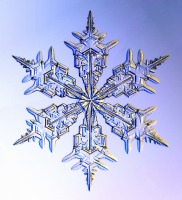
    Snowflake - courtesy of
    www.snowcrystals.com
  • Symmetry: some things are perfectly symmetrical - a tiger`s face (bilateral symmetry), a starfish (fivefold symmetry), a snowflake (sixfold symmetry) or a sea anemone (rotational symmetry)
  • In my Fibonacci post I explained that he discovered that there is a natural sequence called the 'Fibonacci Sequence'. This turned out to be the largest example of Patterns in Nature.
  • Tessellations: patterns caused by repeating a smaller pattern over and over, such as a honeycomb, fish scales, crystals etc.
  • Cracks: hot, dry desert land cracks and splits creating patterns, similar to the leathery hide of an elephant or rhino in a hot climate.
  • Waves and dunes:  created by winds blowing over expanses of sand and forming domes, ripples or crescents, rivers meandering through the land, like a snake, taking along the river bed sand and rocks and over time causing erosion.
    Poison Dart Frog
    (from www.wikipedia.org)
  • Spots and stripes are found very often for camouflage reasons - a leopard hiding in grass, a chameleon blending in with its surroundings.  Bright patterns and colour tell predators that they taste bitter or have a secret weapon inside them like poison like the poisoned dart tree frog in the picture.
  • Snowflakes: each and every snowflake is different - that never fails to amaze me!  Yet every single snowflake is completely symmetrical.
  • Self similar - this means that although the pattern isn`t exactly the same as something else of its type, it is the same as the rest of itself (if that makes sense!) i.e petals.leaves of a fern, coral etc.

Dew on a spider's web
Spider`s webs fascinate me, especially when they are covered with dew or a light frost.  They are so intricately spun, and every thread has a function.  At this time of year when the ground is covered with frost and ice the patterns are amazing, even fallen leaves on the ground and grass takes on a magical appearance when covered in tiny white crystals.

Frost brings out the lines on
fallen leaves

Frost shows up waves in a
fallen tree
Patterns in Nature are found in animals as well like Tigers, Leopards and, of course, Zebras.


Anyway here are some links to some more information:

Wikipedia - Patterns in Nature

35 Examples of Patterns in Nature


Here is the Google Images result for 'Patterns in Nature'

Google Images - Patterns in Nature

Hope you enjoyed,

Z.