Showing posts with label Birds. Show all posts

Friday, 19 February 2016

Post 390 - Brilliant Black Brant amongst Beautifully Graceful Brent Geese

Brent Geese (Branta bernicla)
Hey everyone, today's post 390 and as you'll know, earlier in the week I went to Spurn Point which is about a two and a half hour drive from where we live. It's such a good place to go to, there's so many reserves just packed into the small area, that you're bound to find something unusual or interesting. When I did my post on my trip to Spurn I mentioned I saw a flock of Brent Geese at Kilnsea Wetlands, a new one for me, but amongst them was one that I wasn't expecting to see either, a Black Brant! As there weren't any other birders around to confirm I wasn't 100% sure but I was pleased when I saw this tweet from today:


It was a tricky thing to get photos of as the birds were doing what they do, feeding, swimming about and flying off quite often. I didn't work out what kept disturbing them. I looked back through my photos and I did manage to get a reasonable shot of it.

So, what did I found out about not only the Black Brant, but Brent Geese in general?

The Black Brant - centre of picture
  • Well, firstly, there seems to be about 560,000 Brent Geese worldwide, while there are only 115,000 Black Brants.
  • I'm not 100% sure how many Black Brants there are in the UK, but there are about 100,000 of the normal Brent Geese.
  • The Black Brant is basically a subspecies of Brent Goose, sometimes called the Pacific Brent Goose. 
  • Black Brants usually live in Alaska where they breed and move to Baja, California for the Winter. They are a scarce visitor to the UK
  • The Brent Goose is an Amber Status bird in the UK, but is doing better in Europe and Globally.
  • They almost became extinct in the 1930's because there main food source 'Eelgrass' became almost extinct, too, with disease. 
There were quite a few at Kilnsea
  • Nowadays, Brent Geese have moved a bit inland to find their food, looking for agricultural land for other grasses and winter-cereals.
  • They are found, only Wintering on the Coasts of North, East and South England as well as most of Ireland's coast too.
  • It's about 60cm long with a wingspan of 115cm, with both Male and Female birds weighing quite a hefty 1.5 kilograms!
  • They do seem to be declining, though, for example, the Black Brant alone has declined from about 200,000 to what it is now.
  • This is because of reasons such as hunting, foxes and diseases. In fact, of 6 fitted with radio tags in 2002, only one survived because of these pressures. One was found in the larder of an Inuit hunter.
Flying about!
  • They first breed at 2 years, and usually die 9 years later, at 11. My age! :-( The oldest was 28 years, 2 months and 12 days!

Here are some links to some more information:


Hope you enjoyed,

Z.

Saturday, 14 November 2015

Day 365 - Massively Happy to introduce the Mightily Handsome Montagus Harrier

Today is the day. Day 365. Three-Hundred-and-Sixty-Five posts with hardly any days missed. 103,500 views so far. A dream come true. When I started this, even I didn't believe I would finish this blog. But here we are. It's weird because I can't actually write a simple diary everyday for even a week. It boggles my mind how I managed to do it. I think it was because I am very passionate about this subject. I love nature. Before I get on with today's subject, I want to stress that my blog is not finished. I probably won't post daily. What I think I'm going to try to do at least is cover each week an issue, such as getting kids connected to nature, and a species, such as what I'm doing now. My next post will be the making of the blog, so make sure to keep an eye out for that!

So, to mark this very special occasion I thought I would cover a very special bird. The one I chose was at Blacktoft Sands in East Yorkshire and was one of the most incredible moments in my life.

Pair of Montagu's Harriers ( Circus pygargus ) at Blacktoft Sands
Right from the start of my blog when I was reading up about the UK's rarest birds and I saw the Montagu's Harrier I said 'Wow, I really want to see one!' so I was thrilled when I heard there were some at Blacktoft. It is quite near to us but still around one and a half hours away. So when we got to Blacktoft we found a bench outside a hide to have our lunch. Just as we were finishing, someone came out of the hide and said 'oh, you've just missed the harrier!' So we had to sit in the hide for another 2 hours waiting for it. But it was worth it!

They were amazing to watch but they were a long way off so sadly my photos don't do this lovely bird justice but the Crossley ones show you just how magnificent this bird is.

So, here are the facts:
  • Habitats they like include marshes. moors and grasslands. Blacktoft is England's largest tidal reedbed so lots of lovely marshy habitat for them.
The male flying about
  • Their diet is animals that they take from hunting over areas with low vegetation.
  • They are the United Kingdom's rarest breeding bird of prey. This year there were only 6 breeding pairs and I was lucky enough to see one pair.
  • They don't live here all year, they only come to breed here, and the best chance you have of seeing them is in the South of England. They usually aren't found anywhere else in the UK, so this pair at Blacktoft seem to be unusual - but lucky for me.
  • Now, when I say they only breed here, it's true. But that does mean they need to undergo a migration. So, I looked into this a bit more..
  • Well, they seem to spend most of the rest of their time down in Africa. Specifically in Mali with what's been found by the RSPB.
  • What they've been doing is satellite tagging 5 different birds (Madge, Mark, Roger, Rose and Rowan) and tracking them around the world.
Swooping around for a while before going back to hunt
  • I will be following Mark, seeing as that's my Dad's name, and seeing where he's been going as they can have some pretty big adventures.
  • So, he started off in London on the 24th August 2015. He managed to get across the channel to near Etreux in just 1 day and spent another day resting up. After this he did a weird circle thing over 5 days near Reims and then managed to scale France by the 3rd of September.
  • He then covered all of Spain in the next day only to make it into Africa by the 6th! He carried on trekking along Western Africa slowing down eventually when he hit the border of the Islamic Republic of Mauritania and on the 11th, he went slowly down to the Southern border in 10 days.
  • So, you can see, they undergo huge journeys in such little amounts of time. I'm personally not surprised at all that he slowed down in Africa. 
  • They live for an average of six years but the oldest one recorded was nearly eight years old, he must have flown thousands and thousands of miles!
  • They are a medium sized UK bird of prey with a length of only 40 cm - 50 cm and its wingspan is around 1.1 metres, Still seems impressive to me I'm only a bit taller than they are wide!


Montagu's Harrier from the Crossley ID Guide Britain and Ireland


Here are a few links to some more information:


Thanks for a great year with all of the support, lots of people have been really helpful and supportive and it would need a really long blog one day to thank everybody!

I really hope you enjoyed it, but it's not over, it is never over,

Zach :-)

Monday, 9 November 2015

Day 360 - Resplendant Redpolls

Lesser Redpoll (Acanthis cabaret)
Hey everyone, today's Day 360 and as there's only 5 days to go, I thought I would cover a special species. As I don't come across new birds  very often, I thought I would cover one I saw recently that was a lifer. As you know, a while ago I went bird ringing with the East Dales Ringing Group and saw quite some migrating birds. This particular one is called the Redpoll and they are really cute little birds. As this was the first time I'd seen one it was really special to see them up close, I loved holding and releasing them.

So, here are the facts:

  • There are several species of Redpoll so straight away I'll say that this is the Lesser Redpoll.
Showing off its little black 'goatee beard'
  • They are resident all over the UK apart from right in the centre of England where they only Winter.
  • In the whole of the UK, there are only 220,000 breeding pairs. Well I say only, that sounds quite a lot.
  • Well, despite these facts, they are a RED STATUS. The BTO says this is because there has been a recent breeding decline.
  • This breeding decline was very recent as in the last assessment they were an Orange Status and the time before, a Green.
Beautiful to get close to
  • They are mainly found in woodland habitats, especially coniferous and birch woods but might be lucky and see them in towns or arable areas though not as often. 
  • They feed on small seeds. Especially those of Birch and Alder Trees. As well as plants like Willowherb and Sorrel. They also visit bird feeders especially for nyjer seeds!
  • They breed first when they are 1 year old and usually live for only 2 years. The oldest ever bird was 6 years and 26 days.
  • They are 12 cm long and their wingspan is 22 cm. Both Males and Females weigh 11g. 
And very calm as well.
  • Going back to where I saw this post, when I was out bird ringing, their ring size is the second smallest 'A'.
  • One of the things I am still amazed by is how tiny some birds are and even more so how tiny their eggs are. A Lesser Redpoll egg weighs only 1.4g!
  • Some Redpolls come here from colder parts of Europe but our resident birds may move around in cold winters too, they may head from the North to the South of England and if its really bad they may hop across to warmer parts of Europe.

Here are some links to some more information:


Hope you enjoyed,

Z.

Saturday, 7 November 2015

Day 358 - Kracking Kingfishers Royally Revisited

6 Days to go!

Kingfisher (Alcedo atthis)
Hey everyone today's Day 358 and before I begin, I would like to thank Jill Warrick Moth Recorder for sending me a lovely 'care package' of Moth information. It'll be very useful!

Today, I was at Fairburn Ings, and as always when I visit I go to the Kingfisher Screen. Now this is generally a great place to see, you guessed it, Kingfishers. I've always thought this to be a bit of a myth but it did ring true with me once when a Kingfisher was sat for ages in full view on a wire across the beck here. Unusually I didn't have the cameras with me. Ug. But today, it was a happy day. My family were there, looking through the screen and my Mum saw a glimpse of blue. And there he was in the distance, with his back to us. We got some pictures and it very obligingly came closer, then closer again! I did cover Kingfishers back on Day 132 but I only had some distant photos. After today's experience I had to take another look at them, I've tried to find different information this time too.

So, here are the facts, revisited:
It started of quite a way off!

  • They are resident around most of the UK except for Northern Scotland and about halfway down the West side of Ireland.
  • I always say that they are quite rare, it's almost true. There are only about 4,000 breeding pairs in the whole of the UK.
  • Because of this and that they are a species of European Concern, they are an Amber List species.
  • They are found basically in places where there is water, but only inland. They favour rivers and ponds.
  • They first breed at one year old and they only live for around 2 years. The oldest one was only 4 years 6 months and 13 days.
Then it cam a bit closer
  • They are only 16cm long and they have a 25cm wingspan. Both Males and Females weigh only 40g.
  • Now, why do they hang around streams and rivers. Well, they are there for food. Specifically, fish and aquatic insects.
  • They also nest in stream banks. Both the male and female will work to make a burrow in sandy soils. They are normally only just wider than the Kingfisher, about 6cm wide, but are 50-60cm deep or long.
  • At the end of the tunnel a little dip is made so eggs don't roll out of the nest but the Kingfishers don't use any nesting material.
And then very close :-)
  • In each clutch they have between 5 and 7 chicks and they have between 1 to 2 broods a year and sometimes have a 3rd.
  • They are quite clever as when they are in the nest they operate a rotation system where each chick gets one piece of food and then it moves to the back of the nest to digest its food letting its siblings get food before it starts again.
  • Still on the subject of food, the brood can demand up to 100 food items every day meaning the parents need to be very good at spotting and catching prey.
  • When I was recording this Kingfisher, I noticed that every time there was a gust of wind and the branches went up and down, he would negate it by bouncing up and down again! Like his own little suspension system!


Here are some links to more information:


Hope you enjoyed,

Z.

Thursday, 5 November 2015

Day 356 - Remarkable Redwings

Redwing (Turdus iliacus)
Hey everyone, today's Day 356 and a while ago, I was asked if I'd like to do some bird ringing by the East Dales Ringing group. Obviously I said 'Yes plese' and it was a great time to do it as it was just as migrations were in full swing. It was an incredible day. So, one of the things that I saw was the incredible Redwing, this was one of the species that they were hoping to see and they have ringed over 300 this Autumn.  They are immigrants and a lot pass through the UK at this time of year and they are lovely to see.

As usual I did my research and here are the facts:

  • They found Wintering all over the UK and they are found resident in the North of Scotland. 
  • I say they are resident, well, they do breed here, but there's hardly any of them at all. 
Ready for release
  • There's only between 4 and 16 breeding pairs in the whole of the UK! I don't think I've seen any less!
  • Well, there's obviously gotta be some Wintering birds. Well, there's a more than a few more than 8... an amazing 690,000 birds!
  • Putting all of these previous facts together, we get a Red Status bird! The BTO say this is because there's been a recent population decline.
  • They are 21cm long and they have a 34cm wingspan. Both Males and Females weigh 63g. That's about a medium weight.
  • They first breed when they are 1 year old and they usually live for 2 years. The oldest was 11 years, 10 months and 7 days.
Looking good, Yorkshire & the Redwing :-)
  • Going back to the theme of this post, bird ringing, the ring size of this bird is CC. I haven't encountered this ring before.
  • So they come here in the Winter but where from, well they come from places that are much colder like Iceland, Russia and Scandinavia.
  • A lot of the Redwings we see are only passing through on their way to places like the Mediterranean or North Africa.
  •  It's amazing given how far they fly that they are the UK's smallest true Thrush!
Here are a few links to some more information:


Hope you enjoyed, 

Z.

Monday, 2 November 2015

Day 353 - An Awesome Autumnwatch Anniversary & Notoriously Natty Nuthatches

12 Days to go!

Hey everyone, well an exciting post today as it marks the anniversary of when I started my blog. As a major co-incidence my very first post was about Awesome Autumnwatch Extra which I managed to see from the studio last year - and today is when Autumnwatch starts up again! I thought that was quite a big coincidence!

Well as it's Autumnwatch I've got a couple of special things today. The first is a little video I did for a little Autumnwatch campaign that they are doing #Mypatch. I had great fun doing it even though it was a bit wet!


So what species could I do for a special post like this, only my favourite woodland bird. Now there's a story here too. I have been planning to do this bird for a while. I've seen them lots at Fairburn Ings but that was before I had my camera, so no shots from there! Then I heard there were lots at Littlebeck Woods and had a few trips there to find and photograph them, but no luck there either. Well, looking after nature pays off. Our garden is kept for wildlife, it's only small but has plants that wildlife likes, we have nest boxes and feed the birds every day. So after all my travelling and watching, what turns up in my garden? A lovely Nuthatch!
Nuthatch (Sitta europaea)

I'm very pleased. For the last two weeks at least it has visited our feeders everyday and is getting quite used to me looking through the window with my camera. So I've got some nice shots and a little video.

Well as usual I did my research and what did I find out?

  • They are resident across England and Wales. Don't think they have made it very far into Scotland or Ireland yet.
  • This is a lot bigger area than they used to inhabit in the 1970's - before this apparently they didn't often breed further north than Harrogate - that's an hour away from us and I'd have had to set up camp in my Auntie's house to try to see one!
Being watched
  • There are around 220,000 breeding territories across the bits of the UK they inhabit.
  • Habitats they like are broadleaved woodlands and villages but they will visit parklands and towns too.
  • They have a typical lifespan of about two years but the oldest recorded was 11 years and 9 months!
  • Generally they are 14cm long with a 24cm wingspan and weigh around 24 grams.
  • Their diet changes with the seasons. In the summer they eat insects mainly but as it gets colder and they get less in number they start to eat seeds or it will search bark for insects.
  • A unique thing about Nuthatches is that they can climb up a tree but can also climb head first down a tree! Apparently the only UK bird that can do this and its down to their strong claws and not having stiff tail feathers.
Feeding up!
  • Nuthatches, once they establish their home, actually stay with that one for their life. This gives them a understanding of the area. 
  • Having a year round territory like this is unusual for a small bird, it is more common in bigger birds.
  • I think this basically means that the one at my garden will come here until it dies. I hope its chicks might though as well.
  • Another thing adding to this, is that they will cache seeds and nuts for the Winter, kind of like Squirrels... That's why knowing its patch is handy. So, it can find its food later.
  • Their beak looks quite sturdy and strong but it isn't strong enough to drill through wood like Woodpeckers.
Well my new resident likes his home so much he thought he'd get in on the Autumnwatch action...


#MyPatch


Here are some links to some more information:


Hope you enjoyed


Monday, 26 October 2015

Day 346 - A Super Sunday

Up close with a fabulous Bullfinch
Hey everyone today's Day 346 and yesterday, I had an incredible Sunday. I started off waking up at what should have been 20 past 7, but because the clocks had gone back, was 20 past 6. Now, it was quite early for a) a Sunday and b) a half-term. This, however was worth the lack of sleep as I went bird-ringing and then I went to help out at my favourite local nature reserve, Nosterfield.

So, in today's post I will be talking about first, the bird ringing, and second, how I helped out at Nosterfield.


I didn't know Goldcrests have tiny feathers
like little eyelashes!
Bird Ringing

Such a cute bird the Long Tailed Tit
Well, the place I went ringing was near the Ripon. In fact it was on the edge of a military training area. now, don't worry, we had clearance to go in there by the people that run it. My favourite, yet nerve-racking, sign was one that I couldn't get a photo of but it said 'Warning! Do not touch any military debris as they may explode and kill you.' I'm not joking, that's what it said. :-D Anyway, on with the ringing. We had what was technically 5 nets set up. We had 2 nets set up in between to hedges so that if a bird flew out of one it would fly into the net. We also had 3 elevator nets set up (they were all joined together). What these were, were just huge nets going up to the top of the trees around it, they could be taken down with hooks on the poles that were holding it up. This was probably the most productive, due to its size, and we caught some very nice birds. One of these which was actually caught before we got to the ringing place and was also caught 3 times! It was the lovely Fieldfare, now we had seen some of these in the past (see my Fieldfare post here), but we only got some very bad shots of a couple in a field, taken from the car window, but this one was very up close and I even got to hold it and set it free! That's what I love about Bird Ringing, not only do you get to help out the birding community, but you get some really close-up experiences with birds.
A fabulous Fieldfare up close

So, a big thank you to the East Dales Ringing Group for inviting me over to do this incredible activity. 

Nosterfield

Love the lichen on this Nosterfield sign
Well, I've said that I was helping out at Nosterfield but I haven't said what I was doing, well I have been cutting down some saplings and some mini-trees! Now, I didn't just go there with a hack-saw and just start to cut down some random trees. No, no I didn't, . It was an organised by 'the mere minion' (quoting from him) Whitfield. Also, we weren't just chopping down any trees, we were chopping down a lot of the Ash Saplings. Now, both me and Charlie (a Moth Expert that volunteers there) raised the point 'why are we being nasty to Ash, is it National Be Nasty to Ash Day?' or as I called it 'N-ash-ty Day'. Well, the reason that Whitfield told us is that if we didn't get rid of them then they would completely block out the view of the lakes. So, what we had to do was get rid of them at an early age and stop them growing. The process was that I chopped down some of the saplings with some loppers, and my dad painted over the tiny stump with special blue chemicals that would stop them growing. Everybody using the chemicals had to wear gloves as they could be irritating but my Dad somehow managed to get some on his head and turned into a Smurf... :-)

And still time for a walk!
Silton Forest changing colour

After that, well Esme still needed a walk, so my family were off out to another of my favourite places, Silton Forest. I hadn't been for a week or so so it was great to get back there. It was nice to see all of the trees changing colour and see if we could spot any new fungi. I didn't find anything different but it was still nice to walk in the woods. I then went home and sat down in front of a nice log fire!

So, that is my report on my favourite Sunday for a long time.

Hope you enjoyed,

Z.

Sunday, 25 October 2015

Day 345 - Extremely Spectacular European Spoonbills

Six Sleeping Spoonbills (Platalea leucorodia)
Hey everyone, well I did say I'd kept a few species back that I had seen that I thought were quite special for the last few days of my year of nature hunting and today is one of those! Twenty days to go!

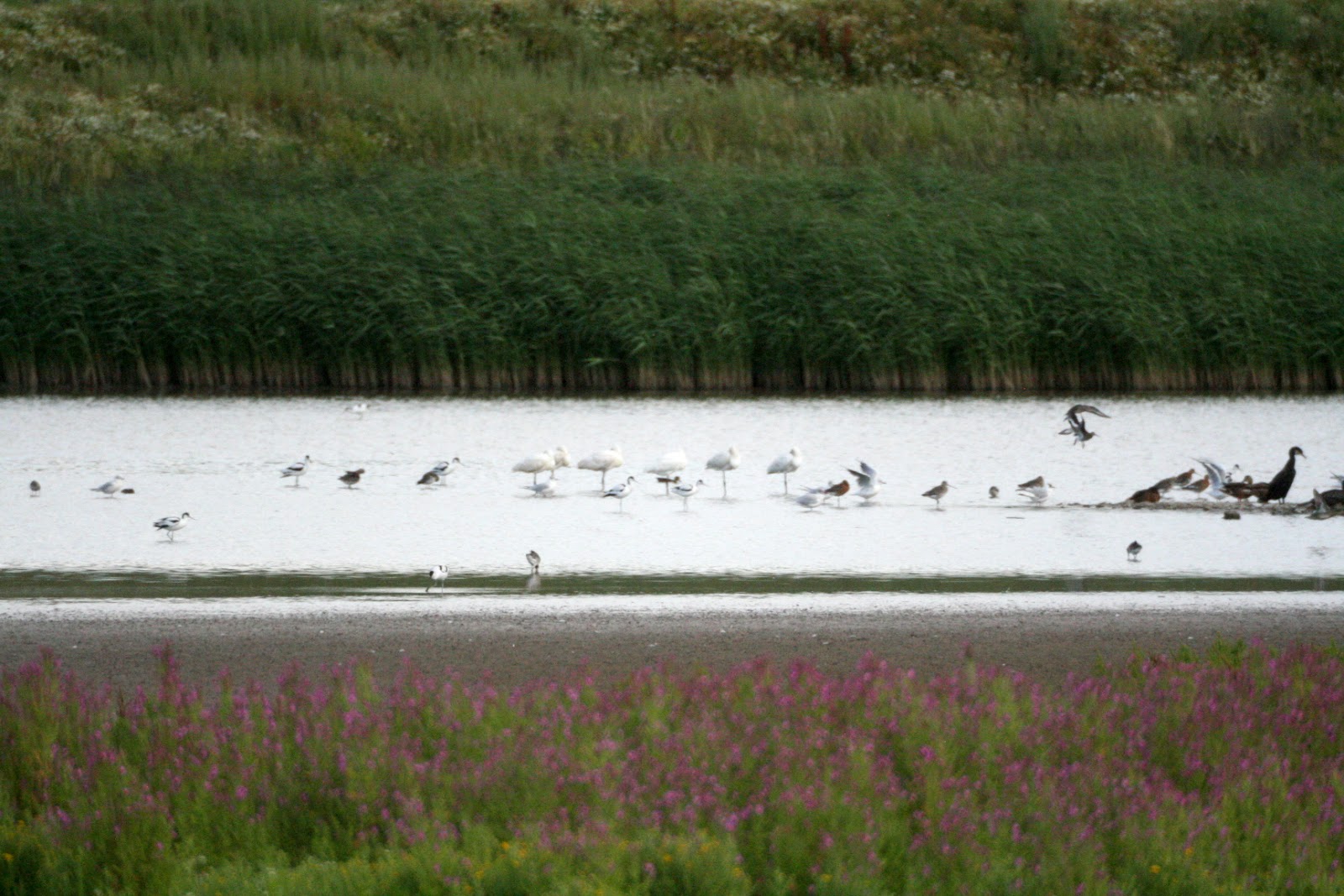
I'm going back to my holiday in Norfolk over the summer for this one. Now something that I find quite annoying is when I have seen birds far better than in my photos. Kingfishers and Spotted Crakes are two species, as well as today's, that I have had really good views of before I got my camera. I saw today's species much closer at Cley Marshes about two years ago. The six in my photo today I saw at Titchwell Marsh in August. They were all sleeping as well so you can't see the feature that gives them their name - their spoony shaped bill - well if you hadn't guessed before I'm sure that you will know now that today I'm looking at Spoonbills!

So what did I find out in my research?
They were at the far side of the reserve
  • They are considered to be a passage bird and you are only likely to see them around the coast of South and East England
  • To find one the most likely habitats you should visit are lakes, marshes and mudflats.
  • In the UK the most breeding pairs recorded is four. In the winter there are a few more, somewhere around 20 individual birds may stay here for the winter.
  • When they do breed they form colonies like herons, maybe even nesting alongside herons, and build a large nest of sticks in a low tree or bush.
  • They lay around 3 or 4 eggs in a clutch.
  • Because their breeding numbers are quite low they have an amber status, they are also a bird of European concern
  • They are quite a big bird on average 85cm in length with a 122cm wingspan. 
  • An average weight isn't known as too few birds have been ringed. This is the same for finding an average age for them.
Spoonbill from the Crossley ID Guide Britain and Ireland
Spoonbills from the Crossley ID guide
This shows them much better than my photos!
  • Their scientific name Platalea leucorodia is made up from Latin and Greek. The first bit is from latin and means 'the spoon bill' and the seccond bit is Greek and means 'the heron'
  • To feed they stir up mud with their feet and then sweep their bills from side to side in the water.
  • This allows them to filter out invertebrates, small fish and amphibians which is their main diet.
  • European Spoonbills are one of six species of Spoonbill in the world.
If you want to find out more try these links:

RSPB - European Spoonbill

BTO - European Spoonbill

Encyclopaedia Britannica - Spoonbills

Hope you enjoyed,

Z.

Saturday, 12 September 2015

Day 304 - Sandpipers Part 1 - Gregariously Smashing Green Sandpipers.

Hey everyone today's Day 304 and as I went back to Norfolk yesterday with Swallowtail Butterflies, I thought I'd stay there. Specifically, one the Broads. Now, I went on another boat ride on Hickling Broad run by Norfolk Wildlife Trusts (- not Ross's he's on Horsey Mere). It was quite fun and we managed to get to a private hide that you can only access by the boat. While we were there, we saw at least 3 different type of Sandpiper. The one I will be covering today is the Green Sandpiper...

...But before I do, I want to share a little wildlife story that happened to me today. I witnessed a giant spider terrorising Yorkshire striding through towns and roads! It was moving at a rate of 8 miles a second! It started off by jumping off a web of clouds and straight onto Thirsk. It then walked along the A19 to Ripon before tearing across some countryside to Harrogate and then onto Knaresborough before zooming along the B6106 and startling the people of Northallerton before finally coming to an end at Hartlepool where it fell into the sea.....it was actually a spider that fell onto the map while I was navigating us through some country lanes on the way back from Lake Gormire. But just goes to show you can spot and watch nature just about anywhere!

Anyway...here are the facts on today's post:
If there aren't many in the UK we did well to see at least three

  • We were quite lucky to see them in the middle of Summer, as there are only 1-2 breeding pairs in the whole of the UK! Only small numbers are found across the UK at this time of year.
  • On top of this though, there are the 910 wintering birds that live here. That's still hardly any at all though!
  • The Worlds breeding population is guessed to be about 2.4 million breeding pairs but it has been estimated 1.2 million either side of that number.
  • Because of the small breeding number in the UK they are a Amber Status but Birdlife doesn't list them as a species of concern.
Looking for bugs
  • They are about 21cm - 24cm and their wingspan is about 29cm. Both Males and Females weigh about 75g.
  • In the UK they are found in Winter in the South but they are found a tiny bit on the North and South-West coasts.
  • They are usually found on ponds and marshes in the summer. When migrating they like wet grass and mudflats but they also seem to like sewage works in the Winter, probably because they can find their favourite foods there...
  • ...Insects (:-) They like to get these of the surface of their feeding grounds and don't probe the ground like some birds
Moving closer
  • It seems they like to breed in forests and lay brown or purple spotted eggs in old Crows nests of Squirrel dreys.
  • They have one clutch of up to 4 eggs each year.
  • They start breeding at two years old and have been known to live over 11 years
Here are some links to some more information:


Hope you enjoyed,

Z.


Wednesday, 2 September 2015

Day 294 - Greatly Wonderful and Excellent Great White Egret

Great White Egret (Ardea alba) - thanks to Dawn Balmer
Hey everyone today's Day 294 and as you know I have recently been to Birdfair and when I was there on the first day there was a huge traffic jam on the way in so we decided to leave early to avoid the jams on the way out so we thought we would do a bit of Birdwatching at Rutland Water Rutland Wildlife Trust reserve. Before we even got out of the visitor centre we were told that there was a relatively rare Great-White Egret just on the other side of the lake. It was quite far away so my camera wasn't very good for pictures but thanks to @_ieuan and @DEBalmer I've got a couple of good ones. I'm very grateful to them as I had written my whole post before I realised my pics were not that good!

So what did I find out about these wonderful birds, here are the facts:

  • It seems they are resident in the Southern hemisphere, but not Antarctica, but they only breed just above the equator.
Another one from Dawn
  • The reason I say where they live in the world is because they aren't normally in the UK. The RSPB doesn't even have a map of where they live here!
  • They don't have any status in the UK probably because either they have been introduced here, or there isn't enough to actually do an assessment on. Globally they don't seem to be a threatened species.
  • What I do know about them, though, is that the Great-White Egret population has risen in the last few years and they are most common in South-East England, as well as East Anglia.
  • Another thing I know is that they are very rare here and there are only 35 wintering birds here in the UK! That's not very many!
/\                  
Much better than mine!
  • They look much like the Little Egret, as the name suggests. The way to tell them apart in Summer is to look for the Greater's Black feet over the Little's Yellow.
  • Also, Greats are much larger, that of a Grey Herons size. As well as this, the beak when they are in Juvenile and Non-Breeding plumage is yellow.
  • I guess it might be because they are a similar size to a Heron that their latin name means white heron.
  • Because of the slaughter of these birds for their plumes, the Society for the Protection of Birds was formed, which, 15 years later, received a royal warrant and because the RSPB.
  • They are 94 cm long and they have a 155cm wingspan. Both Male and Female birds weigh about 870g.
  • It seems they are adaptable and will eat insects, fish in the wet season and small mammals in the dry season.
Here are some links to some more information:


Hope you enjoyed,

Z.

Monday, 31 August 2015

Day 292 - Wonderful Whinchats

Whinchat (Saxicola rubetra
Hey everyone today's Day 292 and I have recently been over to the Lake District to look for Bee-Eaters. Those of you who saw yesterday's post will know I did see them. Now, when I was looking at the map, I saw the RSPB sign. We Googled the reserve and it was only about 4 miles away! Once we were finished with the Bee-Eaters, we headed straight over there. It was a lovely reserve called Geltsdale. It was a lovely area of uplands, very picturesque and very, very peaceful. I hardly heard a sound as Dad and I walked around. We saw 2 (maybe 3) 'lifers'. One of which was the beautiful Whinchat! This one was quite a way away but got a couple of ok shots!

So, here are the facts:

  • They are found all over the UK apart from the ROI and South-East England. They are found in inland East-Anglia though.
Looking around for dinner
  • They are an Amber Status bird because there has been a recent population decline, between 1995 and 2008...
  • ...This was more than a small decline. Between these two points, we lost more than half of our Whinchat population...
  • The reasons/causes for this are unknown but, from what I have found on the internet, there doesn't seem to be any threats to them.
  • There are about 47,000 breeding pairs in the UK so before the decline, there must have been over 200,000 birds!
  • The live mostly in upland moors but they can be found in Heathlands, Marshes and Bogs. Rarely in Towns and Villages.
  • Now, usually when I research their local names I can understand where they are coming from, sometimes less so. But the 'Furzechuck'? No idea on that one?!
  • They are usually about 12 cm long and they have a 22 cm wingspan. Both Male and Female birds weigh 17g.
  • They first breed at one year and their typical lifespan is 2 years but the oldest was 4 years 11 months and 19 days.
Off to catch another bug.
  • They usually lay about 5-6 eggs and have 1-2 broods. They fledge 14-15 days after their 13 day incubation.
  • Whinchats are a migrant bird and arrive in Britain in the Spring from central and southern Africa.
  • Their latin name roughly translates to rock dwelling small bird.
  • Their diet is small invertebrates and sometimes berries. They generally hunt from a perch which fits what this one was doing - it would occasionally launch itself off of the wire to catch something and then returned to the fence.
Here are some links to some more information:


Hope you enjoyed,

Z.

Sunday, 30 August 2015

Day 291 - Beautiful and Elegant Bee-Eaters

Bee Eater (Merops apiaster) in the centre -
the bird on the post was a Great Spotted Woodpecker
Hey everyone, today's Day 291 and instead of keeping you waiting on what today's species is, I am just going to say that I am covering my favourite European bird. The Bee-Eater! Now, I know what you're thinking. But, no. I didn't go abroad. There is actually a pair nesting in Cumbria so I took the opportunity and me and my Dad drove up there. It took two hours but we went though some amazing countryside and knew that when we got there there would be an amazing bird to see! We managed to get some good(ish) pictures. It was incredible to see the different colours on them and how they would take Dragonflies almost the same size as them! Watching them fly and hearing them call was really lovely. We stayed quite a while as the adults hadn't been feeding them for a while, The RSPB were expecting that they would fledge today and it seems that the adults were trying to encourage them out but we didn't get to see them fledge. My photos show these birds off very well, they are really colourful, very beautiful, but they were too far away really  for my camera to capture them well.

So, what did I find out about these amazing birds?:

  • There have been only four records (including this pair) of European Bee-Eaters actually nesting in the UK. This makes them a 'Schedule 1 species' and it's illegal to disturb them.
Both parents were around - one here has an insect
  • They were recorded in Cumbria in 2015, The Isle of Wight in 2014, County Durham in 2002 and the first time was 1994 in Sussex.
  • They are usually found in Southern Europe, Spain and Portugal sort of area, because of this, they aren't actually assessed (green, amber and red) here.
  • The reason they are up here is because they have been pushed up by climate change and are able to stop and nest here.
  • There isn't just one type of Bee-Eater, there are actually 26 species of them, 23 of them are in the family 'Merops'.
A grainy digiscoped shot - with the Golden Ringed Dragonfly
  • The European Bee-Eater doesn't just stay around the South of Europe, it can be found in Africa and as for North as Sweden. An incredible 11 million square kilometres.
  • They are called Bee-Eaters but they don't just eat Bees. They have BEEn (:-) seen eating Dragonflies. You can see the photo to the right of one eating a Golden Ringed Dragonfly.
  • One reason that they may have nested in a Quarry is because they have a lot of dust. Apparently they do something called 'Dust Bathing' to keep down parasites.
  • Bee-Eaters need to catch around 225 bees a day to feed their family (including themselves). I'm not sure how this ties in with Dragonflies but I'd say they must be worth at least two.
  • To get rid of the sting on the Male (because Female don't have them) they will actually rub them against a fence post or something.
In flight
  • They are about 28cm in length and they have a wingspan of 46cm. Both Males and Females weigh about 61g.
  • The juveniles will actually weigh more than the parents when they are a couple of days from fledging as they will eat more.
  • The reason I say a couple of days before is because the to encourage the youngsters out the parents effectively starve the chicks out of the nest by tempting them out with food and not actually giving them it.
  • There are between 280 to 600 thousand pairs in the Summer in all of Europe and in the World, between 2,940,000-12,000,000 can be seen.
  • The nest is up to 3 metres long (I think) and apparently the Males will lose about 30% of their beak when they dig it out.
Here are some links to some more information:


Hope you enjoyed,

Z.

Wednesday, 19 August 2015

Day 282 - Lithely Twisting Little Terns

Little Tern (Sternula albifrons) looking for dinner
Hey Everyone, it's day 282 and I've got another treat today from the lovely North Norfolk Coast. Early one morning Dad and I decided we'd do the walk from Cley to Blakeney Point as we'd been told there was lots of lovely wildlife to see. We weren't disappointed! I've already covered Dunlins and Ringed Plovers which we saw there as well as lots of Oystercatchers, Cormorants and a few other things that I'll cover soon.

One of the most acrobatic sights we saw though was today's little bird. They were great to watch as they soared over the sea before sometimes hovering before they plunged into the sea after a fish. We were watching them for quite a while as we walked and I could have watched them for longer as they were so great to watch. They were hard to photograph though as they didn't come very close, fly fast and turn quick! I'm talking today about Little Terns.

So, here are the facts:

  • They live around our coast but not all around it, mainly its the South & East of England and the North West of Scotland as well as North Wales and a bit of the East of Scotland.
  • Little Terns are the UK's smallest Tern. They are 23cm long with a wingspan of 52cm.
  • They weigh just 56g and they lay 2 or 3 eggs per clutch which each weigh 9.6g so they must get very heavy before they lay them!
    A juvenille in flight
  • While they may be little they do live a long time. Their average lifespan is 12 years but the oldest recorded was 17 years 9 months and 28 days!
  • They lay their eggs on beaches but the eggs and the chicks are very well camouflaged and hard to spot. 
  • They don't like to be disturbed though so they do best in places where there aren't many people. Blakeney must be great for them as there weren't many people at all and it's very hard walking on the shingle! 
  • They are an Amber status bird as they have had population declines. This might be because their nesting sites are places us humans like to go to. Birdlife says they are even sensitive to disturbance from bird watchers so we need to give these birds space.
  • There are about 1900 nesting pairs in the UK.
  • They arrive in the UK in April or May from places like Southern Europe, South Asia, Africa or even Australia where they spend the winter. They start to head back in August so they don't stay very long!
    .....and again
  • Their Latin name Sternula albifrons translates a tern with a white brow, you can just see this in my photos.
  • Don't know how you would catch one of these to ring as they are very fast and agile but if you can get one to ring it they need a ring size B+.
  • They eat mainly small fish but also small crustaceans, insects worms and molluscs. They fish mainly in very shallow water sometimes just a few centimetres deep. When I read this I was surprised as they dive very fast!
Well if you want to find out more about these lovely birds try:


Hope you enjoyed,

Z.

Tuesday, 18 August 2015

Day 281 - Respect-Worthy Ruffs

My favourite sign on the way into Weybourne
Hey everyone today's Day 281 and I've got a bird that I saw in Norfolk recently. Yesterday I told you everything I saw there which, I have to admit, was much more than I had ever realised. That's why I love to do those posts. When you see them over a long period of time, you don't think it's much, but when you put it down 'on paper', you see how much you actually saw. I forgot to put in this picture which is my favourite sign I see when I'm down there.


Ruff (Philomachus Pugnare)
But anyway, in yesterday's post, I said that I saw some Ruffs. This is true and they are what I am going to be covering today. But before I do, there's a little story about the first Ruff that I ever saw. It was at Titchwell and I was just in the Island hide when there was some people talking about Ruffs and that there was one just outside the 'window' and when my Dad pointed it out, I saw that it only had one leg. Now, usually when this happens they are just resting, but this one actually only had one leg but it soldiered on and it looked like It was at least 2 or 3 years old.

So, here are the facts:
A Ruffled Ruff!
  • They only really Winter in some very specific places such as South-Eastern Ireland and South England.

  • They are only resident in Western Norfolk but not many do. There are much more that Winter as I shall explain below.

  • There are only, at most, 11 breeding Females in the whole of the UK but as I said there are more that Winter here, about 850 birds.

Pair of Ruffs
  • Because of this, they are a Red Status. The true reason is because of a recent population decline.

  • Their Scientific name (Philomachus Pugnare) means pugnacious to fight. I'm guessing that that means that they want to fight or are very good fighters.

  • They are 25cm long with a 53cm wingspan. Males weigh a hefty 180g and Females a good 110g.
Ruff on a different day
  • They start breeding 2 years and usually live for 4 years. The oldest was 9 years and 25 days old.

  • The Female's ring size is a relatively large C while the Male is a larger D.
Here are some links to some more information:

RSPB - Ruffs

BTO Birdfacts - Ruffs

Hope you enjoyed,

Z.