Monday, 18 May 2015

Day 196 - Wonderfully White-Throated White Throats

Hi all today's Day 196 and as you know, yesterday I went bird-ringing with the East Dales Ringing Group. We saw quite a lot of birds I don't see that often such as Tree-creepers and Great Spotted Woodpeckers but I did see something that I had never seen before and I definitely never done a post on. Ringing was really fun as you can read about in yesterday's post and I wanted to say thanks again to the East Dales Ringing Group for letting me come along.

Whitethroat (Sylvia communis)
But anyway, on with today's post. As I mentioned above, I saw something that I had never seen before. While ringing it I actually got the opportunity to set it free which was something which was really nice to do. Anyway, from the title, pictures and yesterday's post, you'll know that today I am covering White Throats.

So, here are the facts:
  • They Summer all over the UK apart from central Scotland. Also they don't occur in Lough Neagh and Lough Foyle in Northern Ireland if you happen to be bird spotting out on the water there.
  • I thought they were quite rare but apparently they have 1,100,000 breeding territories around the UK.
All that flying wears their feathers out
  • They are summer migrants which visit us from tropical or southern Africa. That's a long way to fly and as you can see it the photo all that flying actually wears out their feathers, the tail feathers on this little chap were a bit tatty. Still while they are over here they will grow new feathers.
  • Their Latin name (Sylvia communis) has a completely unrelated name to its English name of Whitethroat. You'd have thought that it would be bosco et terrae candida (Woodland Whitethroat) it actually means A Wood Common. 
  • They are found in all habitats especially Reedbeds, Arable Woodlands and Scrubs but they are last common in Moorland and Bogs.
  • They are rather small birds and only have a length of 14cm and a wingspan of 20cm. Both Male and Female birds weigh only 16g!
A lovely little chap.
  • Since I have recently been bird-ringing, I thought I'd include its ring size in my facts. Their ring-size is A, the second smallest ring-size.
  • They have a typical lifespan of only 2 years but the oldest kind of smashed it? Well, he at least tripled it at 6 years 11 months and 30 days. I bet he wished there was 30 days in a month :-(
  • They have a rather normal diet of insect especially beetles, caterpillars and bugs in the breeding season. Towards the end of Summer and into Autumn they usually eat berries.
  • There is an interesting fact on the BTO site which shows how vulnerable some species are. In western Africa in 1968 there was a big drought. This caused 90% of their population to be wiped out - and they are still recovering from this. Just shows its important for us to do all we can for nature.
Here are some links to some more information:


Hope you enjoyed,

Z.


Sunday, 17 May 2015

Day 195 - Brilliant Bird-ringing and Marvellous Moth-Trapping

A view over the river at High Batts from the ringing station
Hi all today's Day 195 and today I had a very early start to get ready for a special day. As you know I go to Nosterfield Nature Reserve (run by Lower Ure Conservation Trust) and the co-founder (Jill Warwick) invited me to do something very special. The place where we went to (High Batts) wasn't too far away from Nosterfield itself so we didn't have to wake up as early as we might have.


A Blackcap
So, on with what I did. To start with, do you ever wonder how the RSPB and BTO get the information and facts that I use in my blog? Well have you ever seen a bird with a small metal ring around its leg? Well that's because of bird-ringers. Bird-ringers are people who set up nets to catch birds and then examine them, record their weight, age, wing length and gender. Then a ring with a unique number is attached carefully to it before it is let free.


My first Whitethroat - and up very close!
If it HAS already got a ring on it then they will record it and then let it go. All of this is done to collect lots of information on birds to try to understand their movement and survival rates. The information helps with conservation of lots of birds. According to the BTO there are around 2,500 volunteer bird ringers in the country that record information on around 1 million birds a year!


Great Spotted Woodpecker
It was really good to see how all this is done and get up close to the birds. It wasn't the busiest session but I still saw some lovely birds. Today there were Blackcaps, a White Throat, Great Spotted Woodpecker, Treecreeper, Willow Warbler and a couple of Blackbirds. I was able to get some lovely shots of the birds up close and got to release some after they were recorded and ringed. Thanks to all the people there for the East Dales Ringing Group, really friendly and I learnt a lot from everyone today!


Here are the spots that give it its name
As if that wasn't enough there were also some moth traps set up overnight. It was a cold night though so not many moths were caught but some very pretty ones were found. I really liked the Hawk moths but some of the smaller moths were really nice too. I shall keep more of a look out for Moths in future!


Lime Hawk Moth
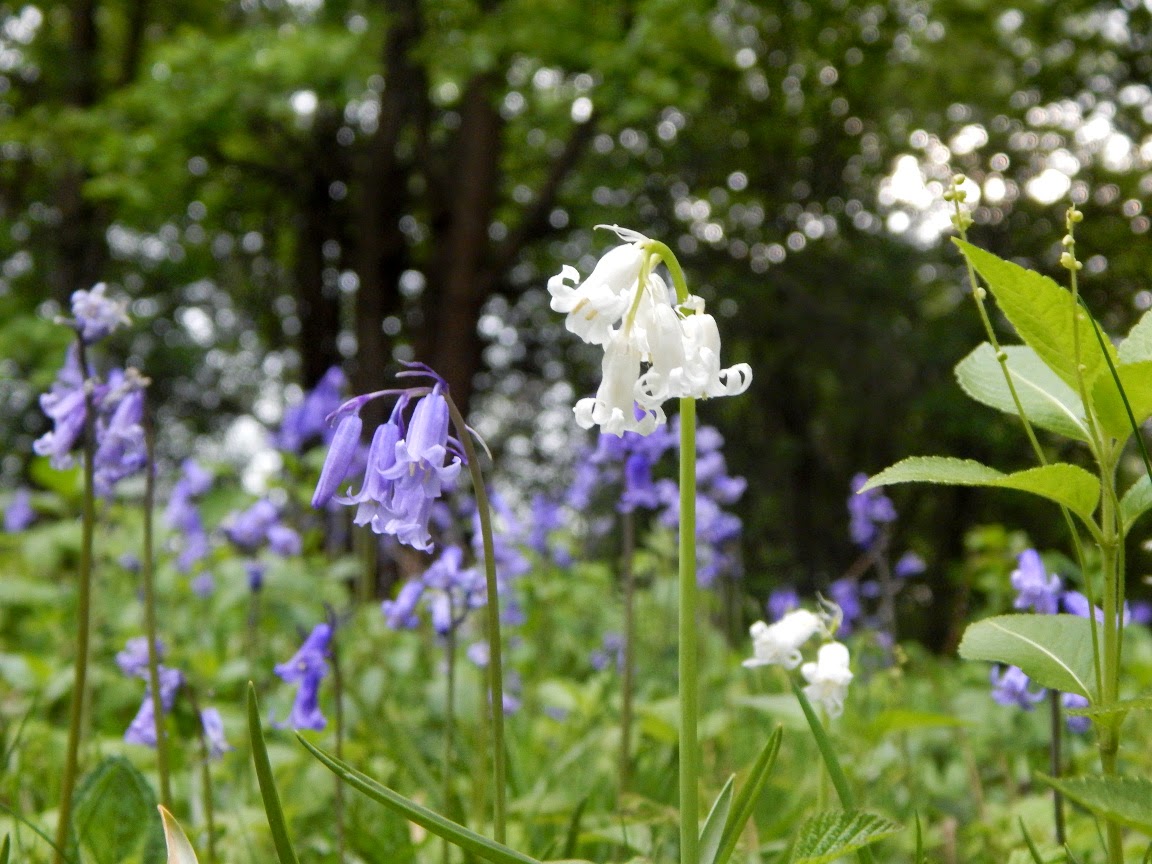
A white Bluebell!
It was an open day at High Batts and there were a lot of different people there interested in different species. As we were making our way out I was able to get close to a little Wood Mouse and saw the end of a little talk on Bats, another species I really like looking out for especially when I'm on my holidays.


There were lots of flowers out too which you can see in the first and last photos. I was surprised to see the white Bluebell, I've never see one of those before!


So if you get the chance I'd really recommend finding out about getting involved in ringing, I'm going to be finding out more and seeing how I can get more involved. If you happen to be in North Yorkshire when High Batts is having an open day I'd recommend that too - it's a really lovely place.

A few links:


Lower Ure Conservation Trust

Nosterfield

East Dales Ringing Group

High Batts


Hope you enjoyed,

Z.

Saturday, 16 May 2015

Day 194 - Swirlingly Swishy Swallows

Swallow (Hirundo rustica)
Hey everyone, it's Day 194 and I've got one of my favourite birds today. I've been looking forward to this post as the alliterations are great too! Trouble is they have been really difficult to photograph being so quick but now I've seen them in a few places this year and I've managed to get a few good photos. Later in the year I'll probably get loads of better ones as they gather on the telephone wires around our house, we get loads just before they migrate. Today I'm going to cover the lovely Swallow.

Wheeeeeeeeeeeee!
I've seen them around my village, but they have been feeding quite high up until lately, I've also seen them at Lake Gormire and today at a place called Camp Hill near Bedale. I went there for a post exam treat and my friend and had a go on a Segway trek, which was great fun!!, but also the Swallows were flying quite low.

So I did my research on these lovely birds and here's a little of what I found:
One that sat still for a minute!

  • As I mentioned above they migrate in the winter so they are only resident in the UK during the Summer but they are seen all over the UK!
  • Our birds tend to head to South Africa for the Winter, a journey of 6,000 miles!
  • The RSPB lists them as an Amber status bird as their population has declined across Europe over the last 30 years. 
  • Happily though Birdlife has them as a species of least concern as they have a very large range and a global population of around 190 million birds.
  • In the UK there are an estimated 860,000 breeding territories.
  • They are 18cm long, have a 34cm wingspan and weigh only 19 grams - amazing that they can fly to South Africa!
A chase at Lake Gormire
  • They typically live for 2 years but the oldest bird was recorded as being 11 years 1 month and 1 day old!
  • They eat insects that they catch on the wing, and are especially fond of catching flies for their young.
  • Swallows are extremely agile and I love watching them as they chase insects and sometimes each other - a couple of my photos here are of a little chase I saw at Lake Gormire.
Are they playing or courting?
  • There is quite a bit of folklore associated with Swallows - 'one swallow does not a summer make' , 'Swallows high - staying dry', this last one though is due to where they are feeding and is only really an indication of the weather conditions at the present time.
  • Prisoners would sometimes have a swallow tattoo to show 'they had done their bird' and sailors would have swallow tattoos to show how much they had sailed, one swallow represented 5,000 miles, two 10,000 miles and so on!
  • They appear in the folklore of a lot of countries - in Denmark: stories tell that swallows told Christ on the way to the cross to 'cheer up', in Germany: told women that if they step on a nest would not be able to have babies, in America:  if a swallow is harmed harvests will be poor......
  • I came across two very appropriate collective nouns for Swallows, they can be described as a gulp or a flight of swallows!
So, a lovely bird and also very interesting, if you want to find out more try these sites:


Hope you enjoyed,

Z.

Friday, 15 May 2015

Day 193 Gloriously Glossy Green Dock Beetles!

Hey everyone day 193 and I've got a treat for any beetle lovers out there!  She was spotted at our allotment on a dock leaf, so we made a guess that she's a Green Dock Leaf Beetle - if we`re wrong and she`s something else please let us know!  We`re saying "she" because my dad found out that if their wings look like they don't quite fit, like this one, it's because it`s a pregnant female and her big tummy means that her wings can't cover her up properly!

So here goes:
Green Dock Beetle (Gastrophysa viridula)
  • They have an amazing metallic sheen to their shells which can look golden, blue, green or purple depending on the light.
  • They are between 4 and 7 mm in length - males tend to be at the smaller end of the scale and females tend to be at the bigger end.
  • Generally spotted anywhere near to Dock leaves, by verges, ponds, woods etc, so widely spread throughout the UK and generally seen throughout May and June
  • They were originally only found in Alpine areas of Europe but from the 20th Century they became more widespread.
  • They have babies generally 2 to 4 times a year.
You can see the wing cases don't fit as she's pregnant!
  • The female lays 100-600 tiny yellow eggs on the underneath of leaves which develop into larvae.  These then feed until they are big enough to dig down into the soil and pupate.  After 6-9 days a new beetle emerges and the cycle starts again.
  • They are diurnal which means active during the day, 
  • In late autumn they start eating a lot more than usual so that they are stocked up over the winter, and bury down again into the soil where they will stay until the spring.
  • Their natural predators are frogs and birds.
  • There are about 20,000 species of leaf beetle throughout the world!  And there may be as many as 3 million species of beetle in the world...
  • Beetles are in fact the largest species on earth!  One in four of every living thing (including plants!) is a beetle! Wow I did not know that!
Hope the photo's are ok, they're off an iphone today
  • Beetles vary in size dramatically, from just 0.25mm for the Fringed Ant Beetle, to a colossal 20 cm for the Titanus Giganteus ..... :-/
  • They are easily recognisable because they look as though they are wearing body armour - and they are - because their hard shells protect their soft underbellies :)
So that`s a quick summary of the Green Dock Leaf Beetle, with a few other beetley facts thrown in! If you want to find out more look at:
And for a great little (bit random!) video featuring "Constable Beetle" my mum found on youtube check out (the bit you want is about 2 minutes in to this clip) :    


She says there was TV programme years ago called Squawkie Talkie that was a sort of spoof nature programme, it had the song "beetle beetle beetle of the yard, beetle beetle his shell is very hard" about a policeman beetle (?!) that mum and dad used to love but could never find to show me - until now!! Does anybody else remember this or are my parents completely mad?!


Hope you enjoyed.

Z

Thursday, 14 May 2015

Day 192 - Marvellous Mystical Mandarins

Hey everyone day 192 and today I've got a very special water bird that we saw at the Washington Wetland Centre, so technically it wasn't actually in its natural environment but it's so pretty I wanted to research it anyway. So I hope you like what I found out:
    Male Madarin Duck (Aix Galericulata)
  • Males are easily recognisable as they have such an amazingly pretty and elaborate plumage! They have long bright orange feathers at the sides of their faces and also have orange streamers or "sails" on their backs, and deep purpley-blue feathers alongside black, white and brown ones. It is a favourite of artists and is often the subject of oriental style art.  The females look like a dulled down (sepia!) version.
  • Mandarin ducks aren`t native to the UK, they descended from captive-bred birds imported into the UK in the mid 18th Century, but it wasn't until they then either escaped or were released into the wild that they started breeding in this country. They can still be found in the wild in some parts of the UK though and also in China, Japan, Korea and Russia.
Male and female Mandarin.
  • However they have suffered a serious decline due to the destruction of their natural habitat (forests) and it is estimated there are now only around 1000 breeding pairs across China and Russia.  The BTO have them listed as having 2300 breeding pairs in the UK but this was in 1988, I also found the figure 8000 in the UK on the Living with Birds website and it also says that there are actually more of them around the world than previously thought.  If anyone knows a recent up to date figure please send me a comment! 
  • They are a shy little duck though so maybe this will explain why they aren't well recorded (maybe they`re keeping themselves hidden?!)
  • In the UK they are considered a protected duck and many wetland centres will work hard to keep numbers up.  We love Washington Wetland because the birds are so well looked after there and they really seem as if they are in their natural environment.
Showing off in the sun....
  • However some have been spotted around and about the UK, some near to us here in North Yorkshire just last month at Bolton Abbey, and others at Wharfe Valley.  We will have to go and explore!
  • They prefer small wooded ponds rather than large open lakes.
  • They are extremely agile fliers, and can sometimes be seen perched in a tree! That I've gotta see! (a duck in a tree!)
  • They even lay their eggs in trunks or holes in trees. Once hatched, the babies jump out of the nest and because they are so light and fluffy they just float down to the ground and their mother then takes them over to the water.
  • They are not one of the types of duck that are eaten due them apparently tasting awful! (lucky for them!)
  • In ancient China they were considered a fertility symbol and a pair of Mandarins would be given to a bride on her wedding day.
...and resting in the reeds.
  • However Mandarins, like many ducks but unlike many other types of birds, only pair up for breeding, and once this is over and done with, they will seek out another mate.
  • The Mandarin has a genetic chromasome anomaly which means they are unable to cross-breed or produce a hybrid and so makes it impossible for them to produce offspring with another type of duck. 
  • They are about 45cm in length and have a wingspan of 71cm. Males weigh 630g and females 520g.
  • They like to eat plant material, invertebrates, snails etc.
  • Females don`t quack, but they do make a clucking sort of a noise if they see danger.
  • The maximum recorded age of a Mandarin is 10 years, 4 months and 25 days.
Well that`s about it for this pretty little duck.  If you want to find out more check out these websites:

Wednesday, 13 May 2015

Day 191 Gorgeously Green Veined Whites

Saw this lovely one at Lake Gormire.
Hey everyone today is Day 191 and I`ve got a lovely little butterfly for you today. I'm going to go in to a bit of detail about the life cycle of a butterfly as I think it's fascinating. Hope you do too.

So on with the facts:

Latin name Artogeia Napi or Pieris Napi

  • The green veined white is one of the family of Whites and Yellows, and is often mistaken for its cousins the small and the large white and in fact I'd done a whole blog thinking this one was a small white when dad then told me it wasn't it`s a green veined. D`oh!
  • They can be found pretty much all over the place, from urban gardens, parks and allotments to the open countryside but especially like damp woodlands.
  • Their favourite food is nectar and they particularly like it from bluebells, buttercups, ragwort, ragged robin, cabbages and thistle flowers.
  • Males like the nutrients that can be sometimes found on the surface of water or mud - this is known as Mud Puddling!
  • They are creamy white in colour with greyish tips to their wings and maybe one or two grey spots.  The green on their underside is actually an illusion...oooooh!.....It`s actually a combination of yellow and black scales that makes them appear green.
  • Their wingspan is around 40-52mm. 
  • You can tell a male from a female by the wingtips - they male`s grey tips are broken up, whereas the female's tip colouring is more of a wedge shape.  From that I`m guessing that mine in the photo is a male.
  • They are high in numbers and so are not considered threatened.
  • White butterflies are sometimes called Summer Snowflakes which I think is lovely!
  • A female lays each egg singly and out of each white and pointy egg emerges a tiny little bright green velvety cater-piddler! (Roald Dahl reference :-)
So on to the life cycle of a butterfly in general:
  • Butterflies are invertebrates and part of the family called Arthropods which means they have jointed limbs.
  • Their wings are made up of a membrane covered in loosely attached scales.
  • They have four very distinct and different life stages:  egg - caterpillar - chrysalis and butterfly.
  • The life expectancy of a butterfly varies from species to species - some of the smaller species such as the common blue might only live for a few days :( but other larger ones such as the peacock might emerge in August, feed, hibernate over the winter, mate, lay eggs and still be around to tell the tale in June.
  • A female will lay her eggs on or near a suitable plant - they tend to have a favourite species of plant that they like to lay on.  The eggs are tiny, less than 1mm in size, and differ in shape - a blue butterfly lays disc-shaped eggs while the white lays eggs that are tall and pointy!
  • Out of the egg a tiny little caterpillar will emerge who will usually eat the shell of the egg and then some of the leaves around it, which is why you can often find leaves on your prized cabbages and nasturtiums with little holes nibbled out of them!  
  • They have very limited eye-sight but can detect movement and shape.  A caterpillar has three body sections - head, thorax and abdomen.  
  • The tiny caterpillar will continue to eat until it fills its current skin, and develops a bigger skin under the outside one, which splits open and the bigger caterpillar comes out.  When that skin has become hard, it can start to eat again.  A caterpillar needs to go through this process 4-7 times (called ecdysis).  In its final process a pupal skin develops and the caterpillar feeds himself up and then attaches himself to a secure place such as a nice firm plant stem so that he can pupate (change into a chrysalis).
  • The chrysalis period can last for a few weeks or for some species such as the Duke of Burgundy can last for ten months.  Its body goes through a complete change and finally the skin splits and an adult butterfly emerges, but its wings are small and plump, so it goes through one last process where it pumps fluid through the veins in its wings to expand them, then they need to harden, and once this is complete the butterfly is ready to fly away!  We "grew" some butterflies last summer (Day 186 Perfectly Pretty Painted Ladies) and watched this happen before they flew away - it was amazing!
  • The butterfly then needs to feed and find a mate, and the whole process starts again. 
  • Its body is made up to 3 parts too, and the mouth-parts have a long coiled tongue called a proboscis which it uses to suck up nectar and fruit juices.  Its body is covered in little scales which can be completely flat or quite long, which is why some butterflies look hairy.
  • Most butterflies hibernate over the winter but not always as butterflies, sometimes they hibernate in the larvae or egg stage, the caterpillar stage or the chrysalis stage.
Interesting stuff isn't it - so many complicated processes going on that we just take for granted but is amazing. 

Here are some links to some more information:


Hope you enjoyed,

Z.

Tuesday, 12 May 2015

Day 190 - Super Sand Martins

Sandmartin (Riparia riparia) landing on the nesting wall
Hey everybody it's Day 190 and today I've got a lovely little bird for you. It`s one that we often see at Fairburn Ings popping in and out of the nest site that's been created there and flying over the wetland looking for food. It's the smallest of the Martins and Swallows, recognisable by its brown plumage and short forked tail, it is of course the Sand Martin. So here are a few facts about them:

  • They eat invertebrates (insects) which they catch while flying (known as on the wing)
  • They are an amber status bird as they have had a couple of declines in recent years due to droughts in Africa.
I think I was spotted!
  • There are between 54,000 and 174,000 breeding pairs in the UK.
  • They can be seen in the UK generally from March to October when they then travel back to warmer climates.
  • They are 12cm long with a wingspan of 28cm.  They weigh about 14g and generally live up to 2 years. The oldest recorded though did well at 7 years and 9 months!
  • The males will dig out a suitable nest site in a sandy riverbank, and the female will then take over and make it cosy, lining it to make a warm nest to have her babies in.
  • The tunnels that they dig out and build their nests in can be up to a metre in length!
Showing its lovely eyes
  • Right at the end in a little chamber the female will lay her eggs (usually 4 or 5) and keep them warm with straw and feathers.
  • They belong to the family called European Hirundines along with House Martins, Swifts, Swallows and Nightjars.
  • It`s not always easy to tell them apart as they scoot around all over the place so quickly!  But here`s a few hints to be able to tell them all apart from each other:
  • And now its white belly
    • Swallows have a long forked tail, a deep rusty red chin, and a glossy black-blue head. They can be seen over farmlands and will perch to collect in numbers before migrating.
    • House Martins have a bright white underbelly and a glossy blue-black head and back. They perch in flocks and are often seen over built up areas or water.
    • Swifts are dark brown all over, have longer, thinner, scythe-shaped wings and a medium sized forked tail (not quite as short as the Martin, but not long streamers like the Swallow). They are fast flyers and screech or scream as they fly. Seen around towns and villages as well as open fields, but never perched. A swift actually sleeps on the wing!
      I don't know how they do this with their heads!
    • Sand Martins are paler brown and have a white chin, with a brown band at the neck, then a white belly. They are mostly seen near to water and colonise in sandy banks or cliffs, They are smaller than House Martins, and form flocks, often perching on wires.
Well that`s a quick summary of this pretty little bird. If you want to find out more check out:

Hope you enjoyed.

Z.