Showing posts with label Blog. Show all posts

Wednesday, 29 April 2015

Day 177 - Mutant Bird!

Hi all today's Day 177 and I have been up near the North York Moors in a forest where we see incredible amounts of wildlife. Just on the road up to it we saw rabbits, birds, horses (not wild, but they were tiny!) and the bird that I am covering today. This bird was one that we had never seen before (in this form at least). It was an interesting bird to see so I got my camera out straight away and started taking photos.

Blue Pheasant (Phasianus Tenebrosus)
Obviously you can tell that it's a Pheasant but Pheasants aren't blue are they? Well they are if they are mutants! They aren't technically mutants they are just oddly coloured 'Melanistic Morphs'. David Renwick told me this. Thanks for that Dave! They are very interesting birds to see so, even though I have already covered Common/Ring-Necked Pheasants in a previous post, I thought I'd do a post about them today.

So, here are the facts:

  • A black/dark blue version of a bird that is not the same colour as the rest of its species actually has Melanism. This is basically the opposite of Albinism. It causes the dark coloured pigment Melanin. The same sort of thing that gives you freckles.
  • This doesn't just happen in Pheasants, it happens in all animals. A good example of this is the Black Panther which is a classic case. They have an entire species named after them!
  • There has been an extremely rare black Flamingo spotted on Cyprus just recently in April. If anybody is reading this in Cyprus that knows where it was seen, please get me a photo!
  • Some people refer to these as both Black Pheasants and Blue Pheasants but they are actually the same thing. They are often mistaken for the Green or Japanese Pheasant which looks like a mixture between the Black/Blue and the Common Pheasant.
  • People refer to them as black, as they appear black from a distance but they are actually a dark blue-purple with an iridescent plumage (shiny feathers. Ooh shiny :-)
  • Sadly, Black/ Blue Pheasants are often introduced into Pheasant shooting ranges to give a little bit of variety :-(.
  • Golden Pheasants (Chinese) are another species of Pheasant like the Common Pheasant that we see daily. Here is a link to a website so you can see this incredible bird.
Here are some facts in general about Pheasants:
  • They are the same size as Common Pheasants being 71cm long and having a wingspan of 80cm. Males weigh 1.40 kilograms and Females 980g.
  • Pheasants can cope with bad weather by remaining dormant for days on end. This basically means they can sleep/hibernate but slow down their bodily functions so they hardly need to eat.
  • Speaking of eating (mmm :-) they like to nom on (nom nom nom :-) seeds, grains and shoots (nom nom nom??).
  • Pheasants have strong breast muscles that give powerful bursts to enable the bird to escape harm in a hurry.
  • They can take off almost vertically and can reach speeds of nearly 40 miles per hour! You often see them by the sides of roads so this, hopefully, helps them to get out of the way of cars.
Here are some links to some more information:


Hope you enjoyed,

Z.

Friday, 19 December 2014

Day 48 - Lovely Long-Tailed Tits (Fluffy Lollipops!)

Long-Tailed Tit (Aegithalos caudatus)

Today is the turn of mine and my mum`s absolute favourite bird - possibly the most adorable of all birds the little ball of fluff that is of course the Long Tailed Tit! Always guaranteed to get an awww! whenever we see one!

They have a call that it easily recognisable  - a tssee tssee tssee or tssirup so you can often hear them before you see them.  They tend to flock together in groups of between 10 and 20 and chatter to each other while they hop from branch to branch. They like woodland, farmland and parks and gardens.

Some facts:

  • There are 340,000 breeding pairs in the UK giving them a healthy Green Status
  • They can be seen all year round.
  • Long-Tailed Tits have a distinctive wavy flight pattern.
  • They have a pink, grey-white and black plumage .
  • Shaped like a fluffy ball with a disproportionately long tail hence Long-Tailed Tit.
  • One of our smallest birds. 13-15 cm with 7-9 cm of that being the tail!
  • The tiny little thing weighs less than a pound coin at just 9g.
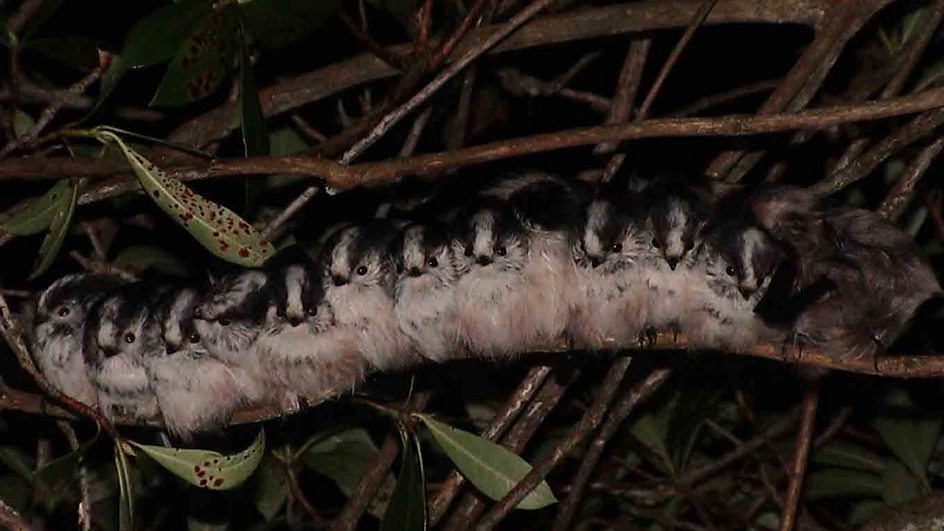
  • To get through cold winter nights they huddle together in their roosts and can loose up to 10% of their body weight overnight keeping warm. See a picture of them roosting here on the BBC Radio 4 website.
  • Long-Tailed Tits have a small beak and find it hard to break into large seeds so instead of this they eat peanuts and suet, but they also like grated cheese and breadcrumbs (must try that!)
  • As well as this they eat insects and larvae and spiders.
  • Both the male and female build their nest together in a gorse, bramble bush or somewhere similar and it can take up to 3 weeks to build! They use webs, moss and lichen to make the nest and it's lined with up to 2000 feathers! 
  • Long-Tailed Tits are cooperative breeders which means that they help each other out especially if inexperienced parents or nest builders are struggling. Parents and chicks that have helpers have a higher survival rate.
  • Winter is a difficult time for such small birds and if it's a very harsh one up to 80% of long tailed tits can perish. However the survivors seem to bounce back quite well and numbers aren't decreasing 
  • In the winter they huddle together in flocks to try and keep warm, all facing inwards with their tails pointing out! (I'd just love to see that and get a photo!)
  • To help these gorgeous little birds leave out their favourite foods on the bird table and possibly leave roosting pouches or nest boxes in nearby trees to try and attract them.
Anyway here are some links to even more information:


BBC Nature - Long-Tailed Tits

Wild About Gardens - Long-Tailed Tits

Hope you enjoyed,

Z.

Tuesday, 16 December 2014

Sensational Siskins


Hi all today is day 45 and I have a beautiful bird that I absolutely love. That bird is the Siskin. You can see it feeding on the right of this text and I'm sure you'll agree that it's a very nice bird. Anyway I think it's now time to get on with the facts:
    Siskin ( Carduelis spinus)  feeding
     (the male Siskin is the top one females are the
    bottom ones)
  • With 369,000 breeding pairs in the UK it is a safe green status as it has had no declines recently. Most of these birds are found across Scotland and Wales but there are some in England in the Winter.
  • They are a small bird about 12cm long with a wingspan of 8-9cm and they weigh 12-18g or about the same size and weight as a Blue Tit.
  • It has a forked tail and yellow stripes on its black wings. It also has a narrow bill as it is a member of the finch family (Fringillidae). 
  • Because of its yellow-green streaks the female in particular can be confused with the Greenfinch however the Greenfinch is much bigger. 
  • Siskins love seeds especially those found on Conifer, Alder and Birch trees. They will also come in search of nuts and seeds on bird tables if they live near by. A good way of attracting these birds to your table is by putting out thistle seeds. 
  • These birds nest in Conifer trees, the female builds a small neat nest high in the tree. This is built from twigs and lichen and lined with feathers and roots. 
  • The female lays 2 clutches of eggs a year which usually consists of 2-6 eggs and she incubates them herself. 
  • They are monogamous birds which means the pair stay together for life although they can colonise with different Siskins. 
  • Siskins remain close to their breeding sites unless food is hard to find so they may have to travel further South. 
  • The Siskin is sometimes known as the Pine Siskin or the Pine Chirper because of the noise they make (if you haven't figured out already this is a chirp). 
  • They are little acrobats and often hang upside down when eating although sadly I've never seen one on a trapeze. (lol).
Here are some links to more information:


Hope you enjoyed,

Z.